About This Blog:

I
thought creating a blog would be an easy way for my family and friends to follow my semester abroad in the Czech Republic, viewing pictures and reading short posts about the places I hope to visit and things I hope to do during my four months overseas. For the less technologically inclined (namely Mimi and my Mom), the blog should be less difficult to navigate and more straightforward than Facebook. In hopes of staying consistently connected all fall, albeit one-way, I will try my best to update the site regularly.

Monday, November 8, 2010

Dresden. So it goes.


I always thought that WWII's influence on this part of Europe would be more marked and prevailing, with numerous statues, museums, and other landmarks remembering that pivotal, not-so-distant era of the world's history. However, European cities seem more preoccupied with the history, culture, art, and architecture of their continent before it was devastated by two industrialized World Wars. In Prague especially, which saw little actual combat, the legacy of the Second World War exists on a more subtle plane, below the surface of the city. Many of the area's castles and fortresses served as concentration camps or important conjunctions between greater occupied Europe and larger camps in Poland, but there is little visible presence of WWII or the Holocaust. The history is here, but it takes some investigation to uncover. I had expected such a momentous chapter to bear more physical scars, especially on the region where it all began and ended. In contrast, the city of Dresden itself serves as a living, tangible memorial to World War II and represents the questions of wartime morality, on both sides, that we still grapple with today. Almost completely destroyed in 1945 by 1,300 British and American bombers, the city has been meticulously reconstructed to resemble its appearance before the war. It is one of a handful of places where WWII truly sculpted the contemporary landscape. So it goes.

What sets the destruction of Dresden apart from other German cities that also experienced relentless aerial bombardment was the type of bombing and Dresden's lack of strategic military or industrial importance to the Nazi war machine. Although the Allied commanders that planned and ordered the bombing justified the attack based on what they thought were over 100 industrial factories supplying the German army with armaments and munitions, Dresden, in reality, was a sleepy metropolis, revered as one of Germany's most beautiful cities. Often titled as the "Florence of Germany," the city played a minimal role in the Third Reich's conquests and war crimes and represented the one stronghold of German culture and history not yet touched by the Second World War. When the bombing began in mid-February, 1945, the city had seen almost no fighting and the citizens bore little responsibility for the horrors inflicted on Europe by Hitler. By attacking what was essentially a peaceful city for its association with an aggressive nation, at the end of the war when Germany's defeat was imminent, the Allies drew (and still draw) accusations of war crimes from the international community. The type of bombing also drew heavy criticisms from the public in hindsight, as the Allies employed not only traditional, but incendiary bombs, to destroy Dresden. The incendiary bombs, used in conjunction with specific weather characteristics, created a firestorm that burned for several weeks, incinerating everything sucked into its path. Unlike traditional bombings of the era that destroyed with explosives, a firebombing relied on these indiscriminate tornados of fire to raze buildings. Almost 15 square kilometers of the city were completely leveled to the ground, including all but one the original bridges and most of the Old Town. The inferno created by the fires killed an estimated 40,000 people, which equalled that of the atomic bomb dropped on Nagasaki. So it goes.


The shot on the left demonstrates the severity of the bombing directly following the aerial assault in February 1945. The picture on the right, obviously from the same vantage point, is a modern view 50 years after rebuilding began.

Thus, visiting Dresden was a powerful experience, because we were confronted by the horrors of WWII at every block. Following its utter annihilation, the city was completely reconstructed, so the majority of buildings had been built within the past 50 years. Much of it is now modern architecture, but several Palaces, the famous Opera House, and a number of iconic Churches were rebuilt as they existed before the War. I can't imagine the city's beauty before the war, as the reconstruction was limited in what it could preserve. The bus tour that we took of the city allowed us to get off at our discretion, explore, and get on any of the other numerous buses running the same route. The hills above the city housed a number of castles and seemingly endless neighborhoods of beautiful homes and mansions. Dresden must have been, and must still be a very wealthy area, because the countryside around Dresden was scattered with villas and mansions built before the War. All but one of our roommates, Paul, went to Barcelona, so Tucker, Paul, another girlfriend of ours, Caitlin, and I got to explore the city together. The weather was pretty grim the whole trip which hindered us from walking around as much as we had wanted to, but despite the weather, it wasn't hard to appreciate Dresden's architectural brilliance. 


A random shot of one of the large houses that dot the hills over the city. We stopped in this little town center during our tour for lunch and one would never know they were only a few kilometers from a major city.


The Fraunkirche Church, which essentially translates to the Church of our Lady in German. Completely razed by the bombings, the people of Dresden put great effort into rebuilding this icon of Baroque architecture with great care. The original stones make up some 15% of the new church.


Caitlin and I in front of one of Dresden's many squares. The Elbe River is a few hundred yards behind us.


The famous Semper Opera House. Destroyed in the late 19th Century by a fire and then again in the 1945 bombings, the Semperoper was reopened in 1985 and functions today as it did before the War.

Because it is rather off the beaten path for American tourists and we are probably beyond tourist season for this part of Europe, we didn't meet any native English speakers. The night life was centered around the New City, which was comprised of 130 bars and restaurants densely packed into a few blocks. We ate doner kebabs for eight of nine meals we enjoyed in Germany because the city was so expensive. Doner Kebabs are essentially pita sandwiches with shavings of meat from a huge, oscillating column of chicken or beef. The vision of someone using an electric saw to shave hunks of meat off of collection of several hundred chicken breasts is rather unappetizing, but they are delicious. We also got our daily allowance of vegetables in the lettuce, cucumbers, and onions that came on them. Eating healthy and cheaply is always a high priority...


Roommate Paul, Tucker, and Caitlin at the rooftop bar of our hostel. In our defense, we didn't chose the girly champaign you can see being held in the picture-it was free with the room.


The four of us at a bar on Friday night. The German beer was all that it was cracked up to be.

Amsterdam for Tucker's 21st Birthday is on the agenda for this coming weekend.

Tuesday, November 2, 2010

Hola Espana

Simply put, Madrid was an incredible city, overflowing with energy, culture, and good seafood. Of the cities I've had the opportunity to see, Madrid is second only to Istanbul in beauty and culture. It's grandiose architecture and construction are almost pompous showcases of Spain's powerful past. Europe has always had an obsession with building majestic buildings to flaunt their capabilities and power, but Spain takes the cake in this interminable competition with a number of palaces, cathedrals, parks, and castles that stand as reminders of powerful Kings and empires. The city itself is massive. In comparison to Prague, which has three humble metro lines, Madrid boasts close to a dozen. It was fun to use our Spanish and we found ourselves being able to communicate more of our thoughts than we had expected. Comprehending a native speaking at mach speeds, however, was a different story. We were all thankful that Molly was there to navigate the city with us and talk with store clerks and servers. I don't know how many times she intervened to salvage conversations our high school-level Spanish just couldn't handle.  


Molly facing off with her eternal foe, pigeons, on one of Madrid's numerous squares.

The Spanish people are very warm and fun, love their music and food, and were very receptive to Americans. The most striking contrast between Spanish culture and the rest of the world is their biological schedule. The Spainards have somehow figured out how to function and operate on half the sleep a normal human is supposed to get each night. Everyone, even small children, eat dinner after 10:00 most days of the week, and use a ciesta in the afternoon to briefly recharge their batteries. The kids in the city go out until the Metro system begins its daily operation at 6:00, despite the fact that the sun has fully risen, because cabs are too expensive. Spanish preteens seem to party harder than even the craziest kids at St. Lawrence. They eat lunch about the time my Grandparents eat dinner and sit down for dinner when the rest of the world is fast asleep. Molly brought us to a rather upscale restaurant on Saturday night. We arrived at 11:00, were not seated until 12:00, were served our main dishes at 12:45, and left around 1:30. It'd be like about Olive Garden hopping at 1:30 a.m. 

Molly purged us from our slumber around 10:00 on Friday morning, and with her cracking the whip, we started exploring the city. Unlike Prague, whose sites rarely hide much historical substance, Madrid's architectural phenomena were also interesting places to visit. They contained not just beauty and romance in their appearance, but hosted fascinating tours or art museums. We saw the Royal Palace of Madrid, which has a dozen large reception rooms and over 250 bedrooms. Overlooking much of the city, it was quite a spectacular sight. The Almundena Cathedral, situated right next to the Palace, only added to the enormity of the panorama. Completed in the late 20th Century, it married Gothic architecture with more modern flavored art and decor. Both were astounding examples of what humans could construct without modern technology and machinery. Also, we had to do the Prado, although Molly was the only one with any substantial knowledge of art history.


I really stumbled into this chance to be a chivalrous, caring boyfriend by buying my lady a flower. We even got a picture with the guy who came into the bar selling the flowers after he blew my cover..


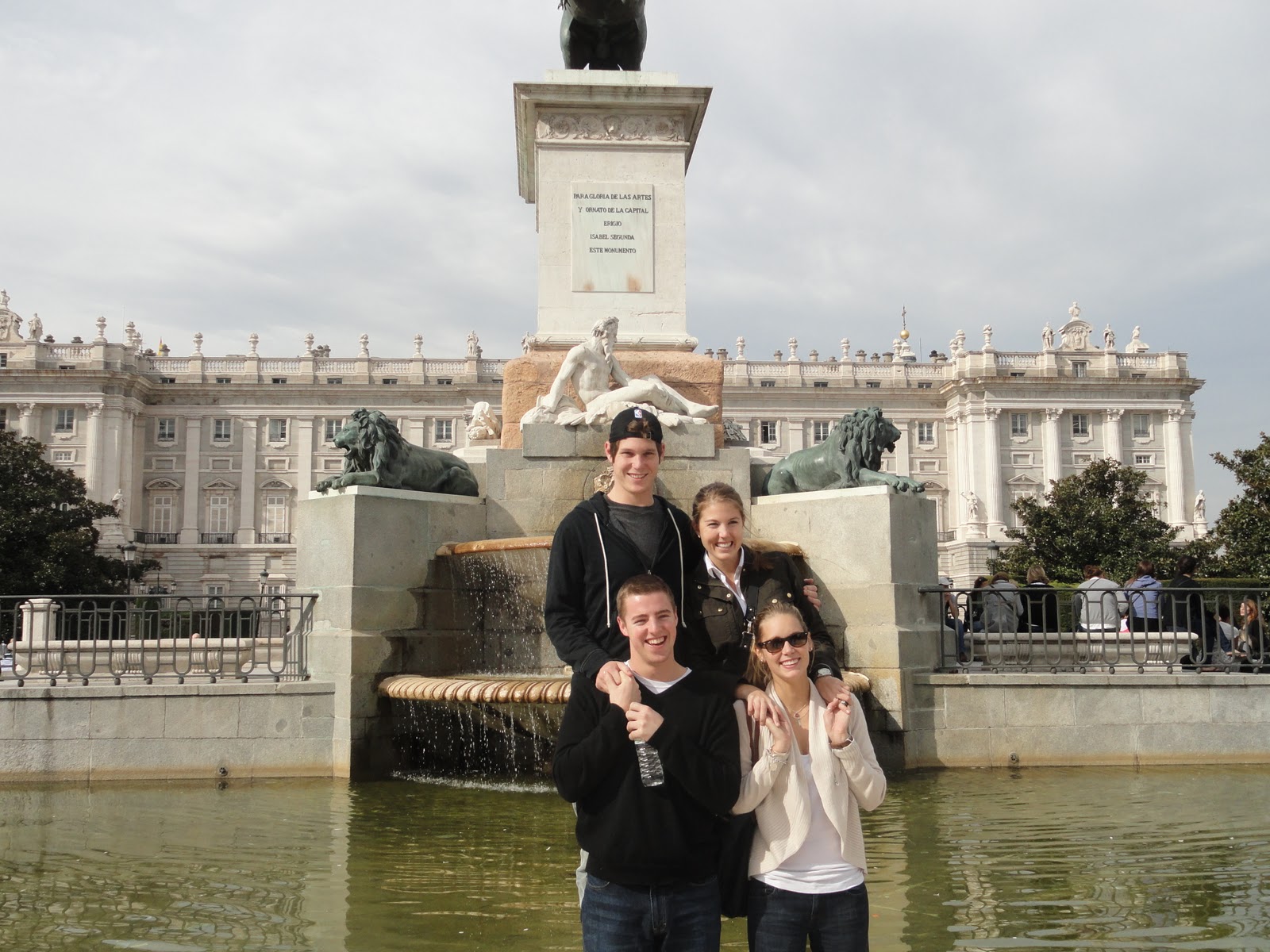
A Portrait on Prom Night. Matt, Caroline, Molly, and I in front of the Royal Palace. About a fourth of the Palace is visible behind us; the massive structure extends far back and to the left.


Again, rallied after an inadequate sleep, we left for Toledo, a smaller, Medieval city 70 km south of Madrid. Our train departed from Atocha, the largest metro station in the city where commuter trains and subways connect to carry an army-sized workforce into the city. It was the site of the 2004 terrorist attacks that killed 190 people and wounded close to 2,000. Being in the same corridors and terminals that saw such carnage six years ago coupled with the recent, prevalent threats to European cities made for an eerie experience. Nevertheless, we took the train to Toledo, which turned out to be an awesome decision because although it is only a quick ride away, it is markedly different than Madrid, evidence of Spains incredible geographic and cultural diversity. In addition to its beauty, Toledo featured the fourth largest Cathedral in the World, an enormous Castle, a Mosque, and a Medieval wall that encompasses the city. The whole city was enveloped by an almost fairy-tale ora that emanated from the buildings, landscape, and bastions that once protected what used to be the capitol of Spain. The city is famous for its swords, and despite our urge to return to the States sporting some badass Medieval weapon, Matt, Tucker, and I gave in to reason and stuck with buying marzipan, another trademark of the city. After Peter Pan in Munich, Aladdin in Istanbul, and Vlad the Impaler from Bratislava, we decided we had adopted enough hero personas.


A view from above Toledo, with the castle dominating the skyline. The city is surrounded not only by stone walls and towers, but also on three sides by a river. There is not much development beyond the little peninsula, so whatever historical society is protecting the city from commercialization has been really successful.


We took a double-decker bus tour in Toledo, which ended up being the perfect means to experience the city in one day. The weather was rather foul so the bus was empty and unfortunately, no one was there to see us all get slapped in the face by a number of trees. I guess that's why we were supposed to sit...


Tucker and I on our trip back early Sunday morning, still in our same clothes from the previous night. It was the Eve of Halloween, so the club we went to, which was a converted opera house, put on an awesome performance of the Thriller dance. Some people just can't handle Vegas... 

This week in Prague is mid-term week. I've got one under my belt, European integration, which I hope will prove to be my most difficult. The EU is so complex and bureaucratic; I don't think many of the officials working within its complicated framework understand it, let alone 10 American students trying to understand a teacher with a heavy Czech accent. So, we'll see how that fares...


Followers